
Every software engineer, DevOps professional, and systems administrator operating command-line interfaces (CLI) across Windows, macOS, or Linux builds their daily workflow around remote repositories and package managers. Deploying code via git push, pulling container layers with docker pull, or fetching dependencies through npm install, pip install, and cargo build demands constant, low-latency data exchange over secure channels. However, when conventional network security tools are engaged, this development pipeline is frequently interrupted by a cascade of critical failures.
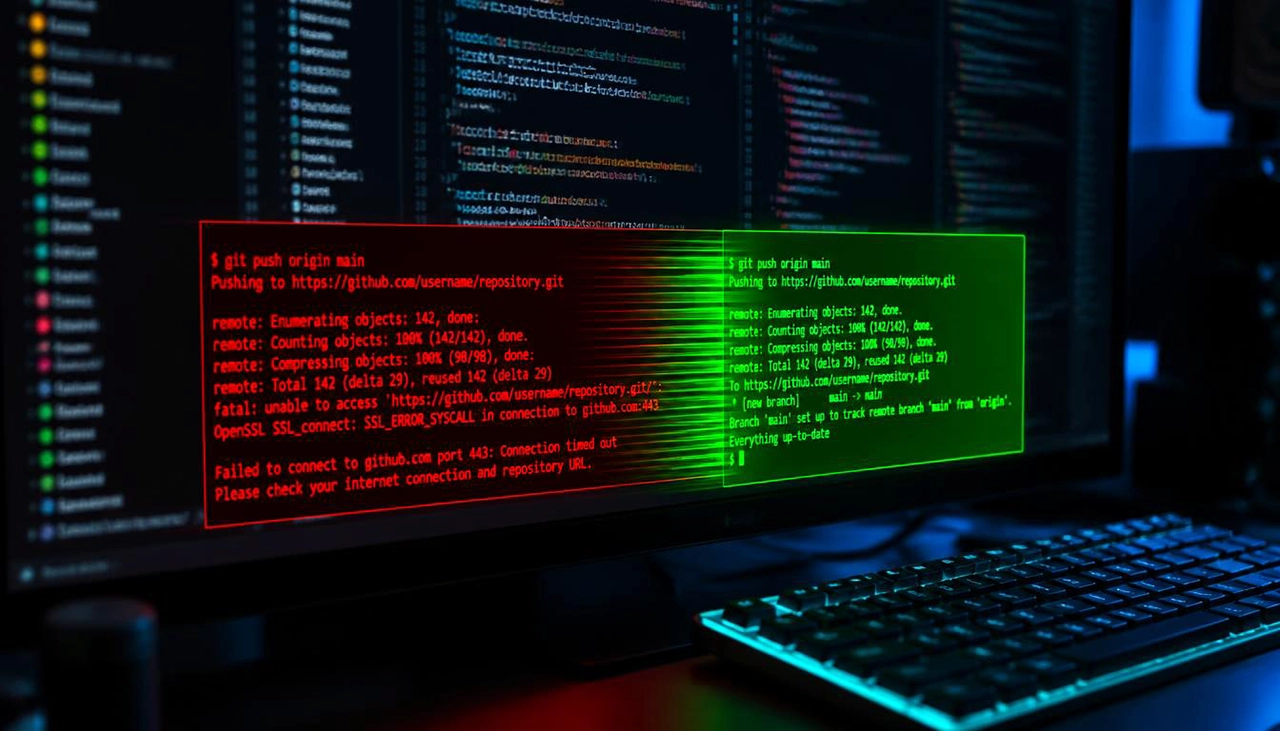
Terminal SSL Handshake Errors in Git, npm, and Docker
The terminal terminal begins throwing systematic warnings such as SSL handshake failed, unable to get local issuer certificate, self-signed certificate in certificate chain, or fatal: unable to access ... SSL certificate problem. Engineers are then forced to either compromise their perimeter security by disabling traffic masking during build phases or append hazardous bypass flags like --ssl-no-revoke or strict-ssl=false into local configuration files.
Let’s dissect the underlying mechanisms of SSL/TLS certificate validation within command-line environments and evaluate how the core architecture of avoVPN allows European developers to maintain an uninterrupted deployment cycle without disabling transport security.
Technical Audit: Why Command-Line Utilities Fail Under Invasive Traffic Interception
Unlike mainstream web browsers (such as Chrome, Safari, or Firefox), which are natively integrated with the operating system’s root certificate stores and can dynamically handle secure exceptions, command-line software operates within an isolated runtime environment. Transport-layer handshake failures under legacy privacy tools are caused by three specific architectural factors:
Trust Chain Alteration via Self-Signed Certificate Injection
Traditional corporate firewalls and mass-market privacy applications frequently employ Deep SSL Inspection. The utility intercepts the secure data stream, decrypts it at a local loopback node for analysis, and subsequently re-encrypts the payload using a locally generated, self-signed certificate. While GUI browsers can be configured to trust this local root authority, standalone package managers (npm, pip, yarn) rely on independent, hardcoded trusted authority files (CA-bundles). These utilities instantly terminate the socket session upon encountering an unrecognized root certificate, flags it as a potential Man-in-the-Middle (MitM) intrusion vector.
Hypervisor Isolation Constraints Within Docker and WSL2 Topologies
Modern European development environments rely heavily on virtualization containers (such as Docker) or the Windows Subsystem for Linux (WSL/WSL2). In these architectures, the container's network stack is isolated from the host operating system via virtual switches. Outdated encryption tools attach a virtual network adapter solely to the host machine but fail to transparently propagate routing tables and DNS parameters down into the underlying virtualized layers. Consequently, CLIs inside Docker or WSL lose the capability to complete the multi-step TLS Handshake with remote hosts like GitHub or GitLab, causing automated image builds to fail.
Deficient SNI Extension Handling in Scripted Runtime Environments
Many package managers are built on interpreted runtimes (Node.js, Python, Ruby) utilizing low-level network libraries. When routing traffic through legacy proxies or outdated cryptographic tunnels, these native libraries frequently fail to append or correctly structure the Server Name Indication (SNI) extension fields inside the outbound Client Hello TLS packet headers. Remote authentication servers at GitHub or package registries like npmjs do not receive the designated target hostname inside the encrypted request stream, forcing an immediate, defensive teardown of the connection on the server side.

Engineering Solutions in avoVPN Desktop Clients for IT Professionals
The desktop and mobile implementations of avoVPN operate on a next-generation Xray kernel utilizing the lightweight VLESS session protocol, which isolates the command-line runtime from certificate verification errors.
Transparent Socket-Level Proxying Without Cryptographic Interception
The core architectural advantage of avoVPN lies in its complete rejection of invasive SSL inspection methods. The application does not attempt to decrypt, parse, or re-sign outbound traffic originating from your terminal. The VLESS transport stack encapsulates the native, encrypted payloads generated by git or npm in their original state, routing them securely to the destination node. The original cryptographic trust chain of GitHub, PyPI, or npmjs remains entirely intact. The terminal successfully completes its TLS Handshake with the remote repository natively, eliminating the need to configure insecure configuration overrides.
Kernel-Level Integration via TUN Mode for Virtualized Containers
The desktop implementations of avoVPN feature a dedicated, kernel-level Virtual Network Adapter mode (TUN mode). The utility establishes a global system-level tunnel that automatically captures inbound and outbound packet arrays across all physical and virtual network interfaces, including Docker virtual bridges, WSL/WSL2 subnets, and local mobile emulators (Android Studio/Xcode). Package managers inside isolated containers gain transparent, unhindered access to external registries through the stable VLESS protocol, removing the requirement to map tedious proxy environment variables inside every separate Dockerfile.
REALITY Obfuscation Safeguards Against ISP Network Constraints
The underlying REALITY subsystem conceals the developer's entire outbound stream by aligning its characteristics with standard, highly trusted HTTPS traffic directed toward global public web services. Deep Packet Inspection (DPI) arrays managed by European telecom providers capture no anomalous data patterns or markers indicative of network proxy tools. This prevents artificial packet delays and false-positive firewall flags, ensuring that heavy Docker layer pulls and repository synchronizations operate at the absolute bandwidth limits of your fiber or cellular connection.
Recurrent terminal SSL handshake errors, failed repository pushes, and the structural dependency on insecure validation bypass flags indicate the presence of legacy network utilities interrupting the TLS chain of trust. Transitioning to next-generation traffic obfuscation frameworks routes command-line traffic natively, preserving the original cryptographic signatures of target servers and maintaining a seamless, high-speed development environment across all containerized platforms.
Secure an uninterrupted, enterprise-ready development pipeline free from terminal blocks and SSL validation faults. Visit the official avoVPN website, sign up for a comprehensive subscription starting at a fixed rate of €1.28 per month for up to 5 devices simultaneously, and activate professional workstation protection for Windows, macOS, or Linux in one click.
You can activate your subscription directly on our official portal or secure professional integration guidance from our technical support team.